
Unlocking Concrete Strength: My Take on Schmidt Hammers
Well, hello there! As someone who's spent years wandering construction sites and labs, I can tell you there are few tools as ubiquitous, yet sometimes misunderstood, as the good old Schmidt Test Hammers. These clever gadgets have been indispensable for engineers and quality controllers for decades, allowing us to quickly assess concrete strength without smashing anything to bits. Honestly, they're a lifesaver, especially when you need a rapid, on-site evaluation.
The Nondestructive Charm of a Rebound Hammer
Let's be honest, nobody wants to drill core samples unless absolutely necessary. That's where Schmidt Test Hammers shine. They offer a non-destructive testing (NDT) method that, while not as precise as core testing, provides an excellent indication of concrete compressive strength. It works by measuring the rebound of a spring-loaded mass impacting the concrete surface. The harder the concrete, the higher the rebound value, and thus, the estimated strength.
The process, as I've seen it countless times, is quite straightforward. First, you prepare the surface – usually grinding away any loose material or irregularities. Then, with the hammer perpendicular to the surface, you press it, triggering the impact. A small indicator on the side records the rebound number. Simple, right? But the magic is in the correlation charts that translate these numbers into estimated concrete strength.
Keeping Them Accurate: The Role of Calibration Anvils
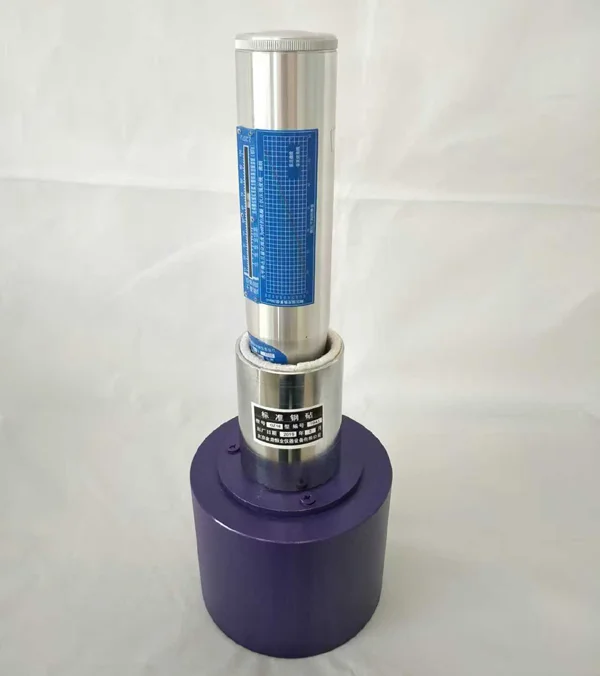
Now, a Schmidt Test Hammer is only as good as its calibration. This is a critical point that many new users sometimes overlook. You see, regular calibration ensures the readings are reliable. This is where specialized calibration equipment comes in, like the ISO Standard Concrete Testing Rebound Hammer Calibration Tester – often referred to as a calibration anvil. For example, a G216 anvil is specifically designed for this purpose.
The G216 anvil, typically weighing around 16kg to 20kg, provides a stable, known surface for testing your hammer. Its durable structure is built to withstand repeated impacts, offering consistent performance. Many customers, myself included, appreciate its precision; it ensures that your hammer measurements comply with ISO standards. Plus, some models even boast hydraulic power for effortless operation – a definite plus when you're calibrating multiple hammers.
Where Do We Use These Hammers? Industries and Applications
Honestly, it's hard to list an industry touching concrete that doesn't use these. Construction is the obvious one, from bridges and buildings to roads and dams. Quality control experts rely on them daily. Architectural engineers use them for structural assessments, and believe it or not, even in precast concrete factories, they're part of routine checks. They're particularly suitable for quick spot checks, uniformity assessments, and identifying areas of potentially weaker concrete. Essentially, if you need a quick strength estimate without making a mess, a Schmidt Test Hammer is your go-to.
Key Specifications (Typical Rebound Hammer)
Feature | Specification |
Measurement Range | 10 - 70 N/mm² (1450 - 10000 psi) |
Impact Energy | 2.207 Nm (Type N, standard) |
Accuracy | ± 0.2 rebound units (after calibration) |
Weight | ≈ 1.5 - 2.5 kg (depending on model) |
Compliance | ASTM C805, EN 12504-2, ISO 8045 |
Service Life | Years, with proper maintenance and calibration |
Industry Trends and Vendor Insights
The market for Schmidt Test Hammers has seen some interesting shifts. While traditional analog models are still popular, digital versions offering automatic data logging and even Bluetooth connectivity are becoming more common. This connectivity makes data management and reporting a breeze, especially for those involved in large-scale projects. I've heard many project managers praise these digital versions for streamlining their workflow.
When it comes to Schmidt Test Hammers suppliers, there's a good range out there. From well-established brands known for their robust, traditional hammers to newer players focusing on digital innovation, competition is healthy. It seems that the key differentiators often come down to build quality, consistency of readings, and the sophistication of their digital interfaces, if any. Certifications like ISO 9001 are always a good sign of a reputable supplier.
Vendor Comparison: A Snapshot
Vendor Category | Typical Features | Target User |
Classic / Analog | Robust, mechanical, cost-effective | Field technicians, smaller projects, educational institutions |
Digital / Hybrid | Digital display, data logging, often with conversion curves | Engineers, larger projects requiring data analysis |
Advanced / Integrated | Bluetooth, cloud connectivity, integrated software, high accuracy | Consultants, R&D, sophisticated QA/QC departments |
Customization and Real-World Stories
While the basic principle of Schmidt Test Hammers remains consistent, some manufacturers do offer customization, especially with their digital models. This might include tailored software reporting, specific language options, or even bespoke correlation curves for unusual concrete mixes. I've seen a concrete producer create their own calibration curves for a unique aggregate mix, which was a fantastic example of customization in action!
Case studies are abundant, from assessing fire-damaged concrete structures to ensuring consistency in mass concrete pours. One particularly memorable instance involved a historical building where core samples were simply not an option. A careful grid of rebound hammer tests provided enough data to confidently assess the structural integrity, saving the project considerable time and money. It just goes to show their versatility.
So, there you have it. The humble Schmidt Test Hammer, a cornerstone of concrete testing, continues to evolve, supported by crucial calibration tools and an ever-growing understanding of its capabilities. It's a tool that, when used correctly and calibrated diligently, delivers incredible value to our industry.
Authoritative Standards & Further Reading
1. ASTM C805 / C805M - 18, Standard Test Method for Rebound Number of Hardened Concrete.
2. EN 12504-2:2012, Testing concrete in structures. Non-destructive testing. Determination of rebound number.
3. ISO 8045:2008, Non-destructive testing - Concrete - Determination of rebound number.
4. Proceq, Original Schmidt Live. (Example vendor reference)


